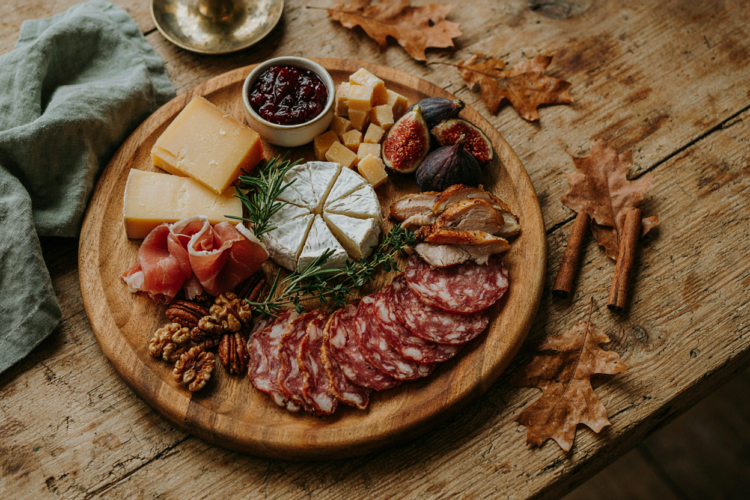
- Seven categories: Cheese, meat, something sweet, something sharp, something crunchy, crackers, fresh
- Per person: 2 oz cheese + 2 oz meat as an appetizer
- Most-forgotten: Something sharp. It is what stops the fifth bite tasting like the first.
- The one thing that matters: Buy by category, not by recipe. Then any combination works.
Most board advice tells you what a finished board looks like, which is not much help standing in a supermarket. This is the shopping list version: seven categories, what to buy in each, and how much.
Get one thing from each category and it will work, regardless of the specific choices. Miss a category and it will feel like something is off without anyone being able to say what.
This page is the shopping list. For how to arrange what you have bought, see Thanksgiving charcuterie board; for choosing the cheeses in more depth, Thanksgiving cheese board.
[Photo: the raw shopping laid out on a counter before assembly — cheese wedges, packets of salami, honey, cornichons, nuts, crackers, grapes]
1. Cheese — choose by teture, not by name
Five cheeses from five teture groups: soft bloomy, hard aged, blue, goat, one unusual. Buying five you like that are all the same teture makes a monotonous board.
The most common mistake is buying five cheeses you like, which turn out to be five versions of the same creamy semi-soft thing. Eating across that board is monotonous even though every cheese on it is good.
Buy one from each of these instead and it does not much matter which:
- Soft and bloomy, brie, camembert, triple crème. The one people go to first.
- Hard and aged, aged cheddar, gouda, manchego. Salty, crystalline, snappable.
- Blue, stilton, gorgonzola. Small wedge; it is a minority interest.
- Goat, a fresh log or aged crottin. This is the acidic one and it resets the palate.
- One unusual, smoked, washed-rind, or something with fruit or peppercorns in it.
Buy: about 2 oz per person total. Five wedges of 4 oz each covers ten people. More of the brie and cheddar, less of the blue.
2. Cured meat
Salami folded into quarters and prosciutto ruffled loosely. Two kinds is plenty, three for more than a dozen. Buy 2 oz per person.
- Salami, folds into quarters and holds a fan shape, which is what you want structurally.
- Prosciutto, ruffles loosely and fills space beautifully.
- Sliced herb turkey breast, rolled into cylinders — the on-theme option, and the one children and lighter eaters actually take.
- Optional third, soppressata, coppa, or bresaola.
Buy: 2 oz per person. Two kinds is plenty; three if you are feeding more than a dozen.
3. Something sweet
Honey, fig jam, dried apricots, fresh figs. Sweet against salt is the fundamental pairing on a board. Without it, the whole thing reads as one salty note.
Sweet against salt is the fundamental pairing on a board. Without it the whole thing reads as one salty note.
- Honey, especially with the blue cheese
- Fig jam or quince paste
- Dried apricots, dates, dried cranberries
- Fresh figs, if the season allows
Buy: one jar plus one dried fruit.
4. Something sharp, the one people leave off
Cornichons, pickled onions, whole-grain mustard, olives. The most commonly missed category and the one that does the most work. Acid resets the palate so the sith bite tastes as sharp as the first.
This is the most commonly missed category and the one that does the most work.
A board is fat, salt and sugar. All three coat the tongue, and after four or five bites the palate stops distinguishing between them, everything tastes broadly the same and people drift away from the board. Acid cuts through that coating and resets it, so the sith bite tastes as sharp as the first. The mechanism is well-understood in sensory science: sour taste receptors on the tongue respond to acidity in a way that refreshes attention when sweet, salty and umami have saturated it.
- Cornichons or gherkins
- Pickled onions
- Whole-grain mustard
- Olives
- Quick-pickled cranberries, if you are feeling ambitious
Buy: at least two of these. They cost very little and they are why people keep coming back.
5. Something crunchy
Walnuts, pecans or almonds, toasted at home for ten minutes. Raw versus toasted is genuinely a different ingredient. They also fill gaps.
- Walnuts, pecans, almonds, toasted. Ten minutes at 350°F, and raw versus toasted is genuinely a different ingredient. The heat releases volatile oils through the Maillard reaction, which transforms flavor and teture in a way nothing else does.
- Candied pecans, for the seasonal version
Buy: one bag. They also do the important job of filling gaps.
6. Crackers and bread
Two kinds of cracker and sliced baguette. Buy more than you think. Crackers always run out before the cheese does.
- Two kinds of cracker, one plain water cracker, one seeded or fruit-and-nut.
- Sliced baguette, plain or lightly toasted.
Pair them roughly: the plain water cracker carries the delicate bloomy cheeses without fighting them; the seeded or fruit-and-nut cracker stands up to the aged hard cheese and the blue.
Buy: more than you think. Crackers always run out before the cheese does, two boes for ten people, plus a baguette.
7. Fresh
Grapes in small bunches, apple and pear slices, pomegranate seeds for autumn, persimmon if you can find it, crudites for a lighter board.
- Grapes, in small bunches rather than loose
- Apple and pear slices, tossed in lemon so they do not brown
- Pomegranate seeds, the single best thing for making a board look like autumn
- Persimmon, if you can find it
- Crudites, if you want a lighter board
What makes it read as Thanksgiving
Pomegranate seeds scattered across, dried cranberries in the gaps, rosemary sprigs tucked in, persimmon or fig sliced. Four additions and any good board becomes seasonal.
The categories above give you a good board in any season. Four additions make it seasonal:
- Pomegranate seeds scattered across everything. Jewel-red, and they catch the light.
- Dried cranberries in the gaps.
- Rosemary sprigs tucked in, they look like miniature branches and they smell right.
- Persimmon or fig, sliced.
Beyond that, arranging it as a turkey does more than any ingredient, see turkey-shaped charcuterie board.
The full shopping list for ten people
Five cheeses, two meats, honey, cornichons, mustard, nuts, crackers, baguette, grapes, apples, a pomegranate, rosemary. One shop, twenty minutes of assembly, ten people fed.
- 5 cheeses, about 4 oz each, one from each teture group
- 8 oz salami, 6 oz prosciutto
- 1 jar honey, 1 packet dried apricots
- 1 jar cornichons, 1 jar whole-grain mustard
- 1 bag walnuts or pecans, toasted at home
- 2 boes crackers, 1 baguette
- Grapes, 2 apples, 1 pomegranate
- A few rosemary sprigs
That is one shop, about twenty minutes of assembly, and it feeds ten as an appetizer.
Scaled to your headcount
| People | Cheese | Meat | Cheese wedges | Crackers + bread | Rough cost |
|---|---|---|---|---|---|
| 6 | 12 oz | 12 oz | 3–4 | 1 bo + 1 baguette | $25–35 |
| 10 | 1¼ lb | 1¼ lb | 5 | 2 boes + 1 baguette | $40–55 |
| 20 | 2½ lb | 2½ lb | 6–7 | 3 boes + 2 baguettes | $75–100 |
If the shop is out of something
| Missing | Buy instead, same category |
|---|---|
| Gouda / manchego | Any aged hard cheese — cheddar, comté, parmesan |
| Brie | Camembert, or any soft bloomy-rind cheese |
| Fig jam | Honey, quince paste, or apricot preserve |
| Cornichons | Any pickle, pickled onions, or a jar of olives |
| Prosciutto | Serrano, coppa, or sliced turkey breast |
| Fresh figs (out of season) | Dried figs, dates, or fresh grapes |
The ratio that makes any combination work
One sharp item for every three rich ones, one sweet for every three salty. Hit those two ratios and the board self-balances no matter which specific cheeses and meats you ended up with.
Tools to put out with it
A knife per cheese (or at least one firm and one soft), a small spoon in each jar, a few toothpicks, a stack of small plates, and napkins. Not food, and the thing most often forgotten.
Make-ahead timeline
| When | Do |
|---|---|
| Day before | Toast the nuts. Slice hard cheese. Portion jam and pickles into bowls. Wash grapes. |
| 4 hrs before | Build the board, minus crackers and cut fruit. Cover loosely, refrigerate. |
| 45 min before | Out of the fridge to come to room temperature. |
| Just before | Add crackers, bread, sliced apple and pear, and do the gaps pass. |
The two rules that matter more than the shopping
Fill every gap with nuts, grapes and herbs until no board shows. Take it out of the fridge forty-five minutes early. Cold cheese is a different and worse product.
Fill every gap. Visible board is what makes a board look sparse. Nuts, etra grapes and herbs into every space until no wood shows.
Take it out of the fridge forty-five minutes before serving. Cold fat carries almost no flavor and reads as way; room-temperature cheese is a different product. This matters more than anything on the shopping list.
From my kitchen
I have a page in the notebook for boards, and it is the shortest page I have. The reason is that a good board needs almost no cooking, which means it needs almost no remembering.
The first board I built was for a Thanksgiving when the oven had two turkeys in it and no room for anything else. I spent twenty minutes in the supermarket and assembled it on the counter while the coffee brewed. It was the most photographed thing on the table, and it disappeared before the turkeys came out.
What I understood then was that a board is not a dish; it is a shopping list arranged on a surface. The skill is in the buying, not the cooking. Once you have the five cheeses, the two meats, the sharp thing, the sweet thing and the crunchy thing, the board builds itself.
Now the page has a line for it: seven categories, one from each, fill every gap, out of the fridge forty-five minutes early. It is the line I turn to when I am short on time, and it has never let me down.
Frequently asked questions
What goes on a Thanksgiving charcuterie board?
Seven categories: cheese, cured meat, something sweet, something sharp, something crunchy, crackers and bread, and fresh fruit. One item from each and the board works regardless of your specific choices.
How much cheese and meat per person?
About 2 oz of each per person as an appetizer before a meal, or 4 to 5 oz of each if the board is standing in for the meal. For ten people that is roughly 1¼ lb of cheese.
What do people forget to put on a charcuterie board?
Something sharp, cornichons, pickled onions or mustard. A board is fat, salt and sugar, and without acid the palate stops registering it after a few bites. It is the cheapest category and the most important.
How many cheeses should I buy?
Five, one from each teture group: soft bloomy, hard aged, blue, goat, and one unusual. Three works for a smaller board, take the bloomy, the hard and the blue.
What makes a charcuterie board look like Thanksgiving?
Pomegranate seeds, dried cranberries, rosemary sprigs and sliced persimmon or fig. Those four turn any good board into a seasonal one without changing the shopping much.
What if the shop is out of a cheese I need?
Substitute within the same teture group, not by name: any aged hard cheese for gouda, any soft bloomy for brie, any pickle for cornichons. The board works on the ratio of tetures and of sharp-to-rich, not on the specific labels.
How much does a Thanksgiving charcuterie board cost?
Roughly $25–35 for si, $40–55 for ten, and $75–100 for twenty at supermarket prices, with leftovers of most items.
The bottom line
Buy by category, not by recipe. Five cheeses chosen by teture, two meats, something sweet, something sharp, something crunchy, two crackers, something fresh. Two ounces each of cheese and meat per head. Fill every gap, and take it out of the fridge an hour early.
Save the shopping list, seven categories and you cannot build a bad board.
— Pearl