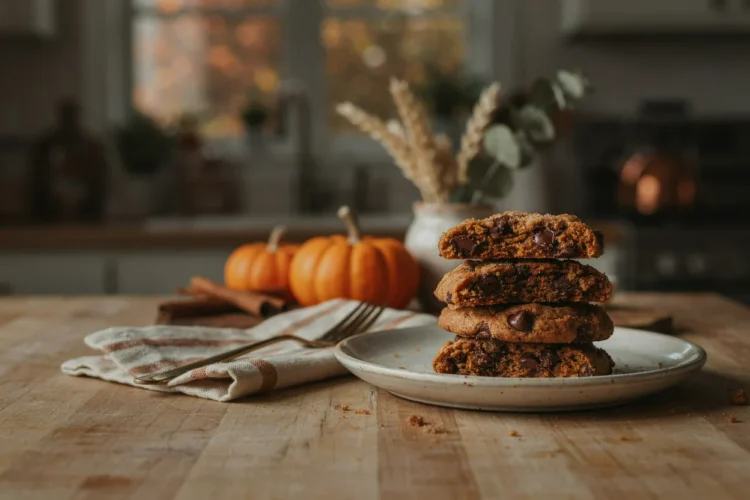
- Makes: About 22 cookies
- Active time: 30 minutes, plus 1 hour chilling
- Oven time: 11–13 minutes at 350°F
- Make ahead: Dough keeps 3 days chilled or 3 months frozen
- The one thing that matters: Chopped dark chocolate, not chips, and a pinch of flaky salt on top before baking
Most pumpkin chocolate chip cookies taste of neither pumpkin nor chocolate. The pumpkin gets buried under cocoa, and the cocoa gets muffled by all the moisture that made the cookie cakey in the first place. This version fixes the muddle with three moves: concentrate the pumpkin, use chocolate that melts into shards and puddles instead of staying in neat buttons, and put salt where your tongue meets it first.
[Photo: a broken cookie held to the camera, chocolate pulling into a strand, flaky salt visible on the burnished top]
Why this works
Chocolate is loud and pumpkin is quiet, so you have to bring them level. Cooking a cup of puree down to six tablespoons doubles the pumpkin’s presence and gets rid of the water that would otherwise steam the cookie into a cake. A teaspoon of espresso powder does not make the cookie taste of coffee; it sharpens the roasted, bitter edge of the chocolate so it holds its own next to the spice rather than turning to sweet brown sludge.
Chopping a bar instead of pouring chips matters more than it sounds. Chips are built with stabilizers to hold their shape, so they stay as isolated dots. A chopped bar gives you thin melted seams, thick molten pockets, and dusty shards worked all through the dough — every bite is different, and the contrast is what makes the cookie interesting. The flaky salt on top hits before anything else and makes both flavors read louder.
What every ingredient is doing
| Ingredient | Job | If you skip or swap it |
|---|---|---|
| Pumpkin puree (reduced) | Flavor — cooked down to concentrate, same as the plain pumpkin cookies | Unreduced = cakey, muted flavor |
| Browned butter | Nutty flavor plus less water than melted butter | Regular melted butter = less depth, more water |
| Dark chocolate (60–70%), chopped | Bitterness to match the pumpkin’s earthiness; chopped for varied texture | Chips = uniform dots, no puddles; milk chocolate = too sweet with the spice |
| Espresso powder | Sharpens the chocolate without adding coffee flavor | Skipping it = still good, just one-note; cocoa powder is a partial stand-in |
| Flaky salt on top | First thing your tongue registers — amplifies both pumpkin and chocolate | Fine salt mixed in does not give the same surface hit; must be flaky, must be on top |
| Black pepper (pinch) | Warms the back of the spice blend without making it peppery | Skipping it is fine; it is a background note, not a main event |
| Brown sugar (mostly) + white | Chew and moisture from molasses; crisp edges from white | All white = crisper, less pumpkin flavor; all brown = too soft |
| Egg + extra yolk | Structure and richness | Whole egg only = slightly drier |
What you need
1 cup (240g) pumpkin puree, to be reduced to 6 tablespoons. ¾ cup (170g) unsalted butter. 2 cups (250g) all-purpose flour. 1 teaspoon baking soda. ½ teaspoon baking powder. ¾ teaspoon fine salt (plus flaky salt to finish). 1 tablespoon pumpkin pie spice. Pinch of finely ground black pepper. 1 teaspoon instant espresso powder. 1¼ cups (250g) light brown sugar, packed. ¼ cup (50g) granulated sugar. 1 large egg, plus 1 yolk. 2 teaspoons vanilla extract. 6 oz (170g) dark chocolate (60–70%), chopped into rough pieces.
How to make them
[Photo: a chocolate bar mid-chop on a board, a mix of chunks, slabs and fine shards]
Pumpkin Chocolate Chip Cookies
Ingredients
Method
- Cook the puree in a skillet over medium heat, stirring, 6 to 8 minutes, until dark, thick, and about 6 tablespoons. Cool it.
- Melt it in a light pan and cook, swirling, until the milk solids are golden brown and smell nutty. Pour into a large bowl with all the sediment and cool 15 minutes.
- Whisk flour, baking soda, baking powder, fine salt, spice, pepper and espresso powder.
- Whisk both sugars into the cooled butter, then egg and yolk, then the reduced pumpkin and vanilla. Whisk 1 minute.
- Fold in the dry ingredients, then the chopped chocolate, until just combined. Chill, covered, 1 hour.
- Heat the oven to 350°F (175°C). Roll 1 1/2-tablespoon balls, space them 2 inches apart on lined trays, and press a few reserved chocolate pieces onto each top. Sprinkle with flaky salt.
- until the edges are set and the centers still look soft. Cool on the tray 5 minutes before moving them.
Notes
- Milk chocolate: works, but drop the granulated sugar to 2 tablespoons or the cookie tips sweet. Keep the espresso.
- Half chocolate, half toasted pecans: 3 oz chocolate and ½ cup nuts. The nuts add a savory note that suits the spice.
- No espresso powder: leave it out; the cookies are still good, just a touch more one-note. A teaspoon of cocoa powder in the dry mix is a partial stand-in.
The doneness guide
Same window as the plain pumpkin cookies — these go from soft to dry in about 90 seconds. Here is what to watch for:
- At 10 minutes: edges are just setting, centers still glossy. Too early.
- At 11–12 minutes: edges are set and matte, centers look slightly soft and barely matte. The chocolate pieces on top are glossy and melted-looking. This is done.
- At 14+ minutes: centers are matte and slightly cracked. These will be dry once cooled. Pull them at the first sign of the edge set.
The details that decide it
- Reserve some chocolate for the tops. Pieces pressed on after shaping stay glossy and photogenic; pieces mixed in disappear into the crumb.
- Salt before baking, not after. Flaky salt added to a hot cookie mostly rolls off. Added to the raw dough ball, it anchors.
- Cool the butter properly. Warm butter plus sugar equals a flat, oily cookie. Give it the full 15 minutes.
- Chill is not optional. An hour firms the fat and hydrates the flour, and it is the difference between a cookie with edges and a spongy disc.
- Chop the chocolate unevenly. You want a mix of fine shards (which melt into the dough), medium chunks (which form puddles), and a few large pieces (for the tops). A food processor makes them too uniform; a knife and ninety seconds is right.
When things go wrong
| Symptom | Almost certainly | Fix next time |
|---|---|---|
| Cookie tastes only of chocolate | Puree was not reduced enough; pumpkin flavor diluted | Cook to 6 tablespoons, until dark and thick |
| Cookie tastes only of pumpkin | Used chips instead of chopped; chocolate stayed sealed | Chop a bar; the varied texture puts chocolate in every bite |
| Cakey texture | Too much water in the dough (unreduced puree, or warm butter) | Reduce puree properly; chill dough full hour |
| Spread too thin | Butter too warm, or dough not chilled | Cool butter 15 min; chill dough until firm |
| Dry cookies | Overbaked — the 90-second window passed | Check at 11 min; pull when centers still look soft |
| Chocolate burned on top | Oven too hot, or chocolate pieces too small on the surface | Use larger pieces for the tops; verify oven temp |
| Bland overall | Old spices, no espresso, no flaky salt | Fresh spice; espresso sharpens; salt amplifies |
Variations
- Milk chocolate: works, but drop the granulated sugar to 2 tablespoons or the cookie tips sweet. Keep the espresso.
- Half chocolate, half toasted pecans: 3 oz chocolate and ½ cup nuts. The nuts add a savory note that suits the spice.
- No espresso powder: leave it out; the cookies are still good, just a touch more one-note. A teaspoon of cocoa powder in the dry mix is a partial stand-in.
- White chocolate: skip the espresso and reduce the granulated sugar. White chocolate brings its own sweetness and pairs well with the pumpkin spice.
- Spicy chocolate: add ¼ teaspoon cayenne to the dry mix. The heat builds slowly behind the chocolate and suits the pumpkin. Pairs well with the pumpkin chili if you are building a spicy autumn menu.
- Double chocolate: add 2 tablespoons cocoa powder to the dry mix and reduce the flour by 2 tablespoons. The cookie goes dark and brooding — more brownie-adjacent. For the full deep-chocolate version, see our pumpkin brownies.
Scaling for a crowd
Double it in one bowl. The only step that scales awkwardly is the reduction, and that just means a wider pan and a few more minutes. These hold up well on a shared tray because the chopped chocolate makes them look handmade rather than mass-produced, which is the point of bringing cookies somewhere.
Bake in rotation, one tray at a time on the middle rack, if you want them even. Two trays at once will give you a pale batch and a dark batch. Plan 2 to 3 per person, and keep a few of the plain glazed pumpkin cookies alongside for anyone who does not want chocolate.
For a holiday cookie tray: these sit naturally next to the plain glazed pumpkin cookies (or their snickerdoodle variation, rolled in cinnamon-sugar) and the pumpkin oatmeal cookies for a chewier texture. Three cookies, three textures, same spice profile.
Make ahead, storing and freezing
- Dough: 3 days chilled, or freeze the shaped balls for 3 months and bake from frozen, adding 2 minutes.
- Baked: airtight at room temperature, 3 to 4 days. A slice of bread in the container keeps them soft.
- Reviving: 10 seconds in the microwave brings back the molten-chocolate quality in a day-old cookie.
- For an event: bake and freeze unglazed up to 2 weeks ahead. Thaw at room temperature, then warm 5 seconds in the microwave before serving. The chocolate re-melts and the cookie tastes freshly baked.
From my kitchen
The complaint I hear about these is always some version of “they were fine, but they just tasted like a brown cookie.” That is what happens when the pumpkin is watered down and the chocolate is in sealed little buttons. Concentrate one and break up the other and suddenly there is something to taste. It is not a subtle difference.
People also tell me chopping chocolate is fussy. It takes ninety seconds and a serrated knife. The payoff is a cookie that looks and eats like it came from a good bakery instead of a tube, and that is worth ninety seconds.
Frequently asked questions
Chips or chopped chocolate — does it really matter?
It changes the whole texture. Chips hold their shape and stay separate; a chopped bar melts into seams and pools, so every bite has a different amount of chocolate. Chopped is worth the extra minute.
Will the espresso powder make these taste like coffee?
No. One teaspoon in a full batch is below the threshold where you taste coffee; it only deepens the chocolate. Leave it out if you are serving children who object on principle.
Why do my pumpkin chocolate chip cookies taste bland?
Too much water in the puree and chocolate that stays sealed in chip form. Reduce the pumpkin to a thick paste and use a chopped bar, and add flaky salt on top before baking.
Can I make them chewier?
Cut the baking powder to ¼ teaspoon and add an extra yolk. You trade some height for more density and chew.
Can I use white chocolate?
Yes, and it pairs well with pumpkin, but skip the espresso powder and reduce the granulated sugar, since white chocolate brings a lot of sweetness of its own.
Can I make these dairy-free?
Use coconut oil in place of the butter (melt and cool, do not brown). Use dairy-free dark chocolate. The texture holds; the flavor shifts slightly but the spice carries it.
The bottom line
Bring the pumpkin up and open the chocolate out. Reduced puree, a chopped dark bar, a little espresso, and salt on top before it bakes. Then you get a cookie that tastes of both things at once instead of neither. For more pumpkin baking, the plain glazed cookies are a simpler version of the same idea, and the pumpkin bars scale it up for a crowd.
Save it for the next time chips are all you have and you wonder why the last batch fell flat.