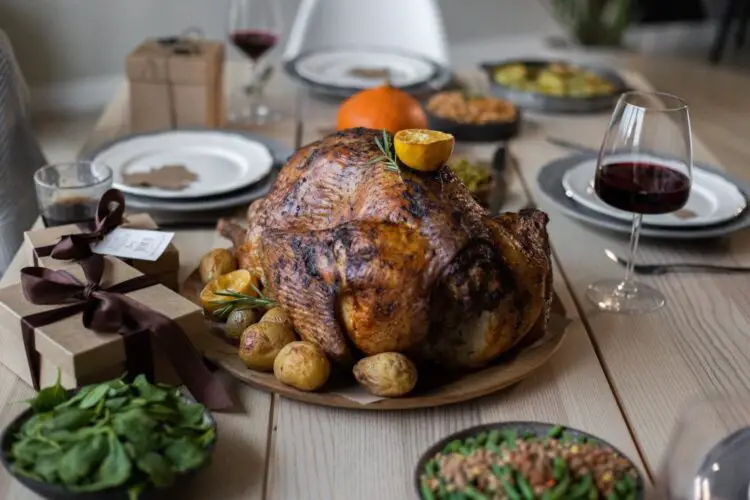
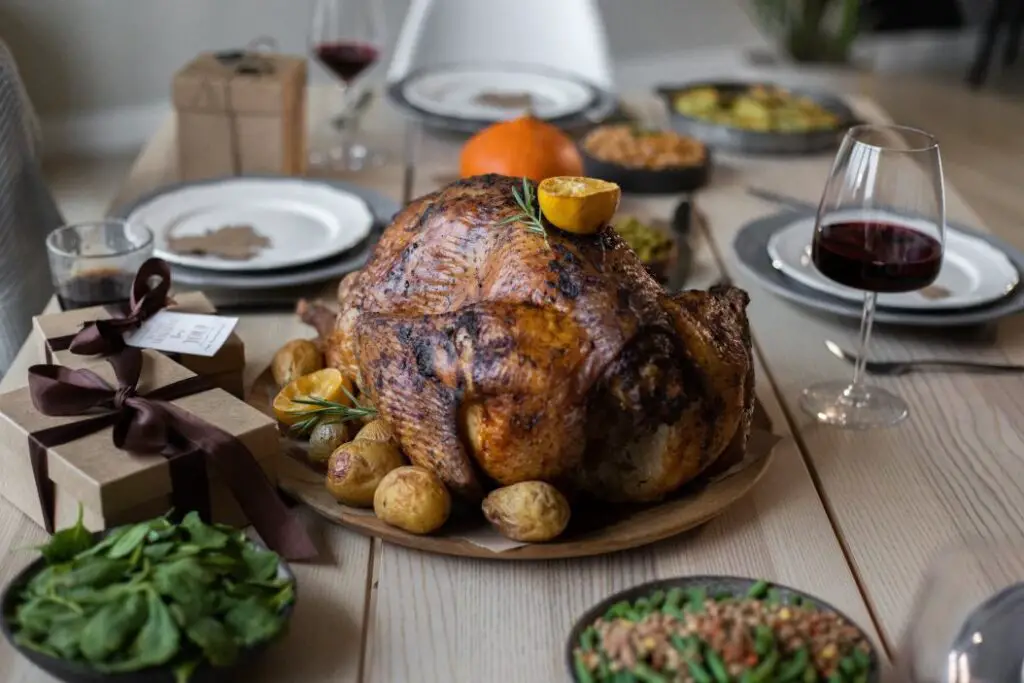
Thanksgiving dinner always involves friends and family around the dinner table, so how best to cater to a larger group? Just how many pounds of turkey should you prepare to avoid disappointing anyone?
As a rule of thumb, an average adult will consume 1/2 pound of turkey meat at Thanksgiving. A child will consume about 1/4 pound of turkey meat, a woman will consume 1/3 pound of turkey meat and a man will consume 2/3 pounds of turkey meat.
A roasted turkey though does not come as “meat alone” but includes bones and skin, so how do these quantities translate into a store-bought turkey, ready to eat?
1/2 pound of turkey meat means about 1 pound of turkey meat and bone. An average adult will consume 1 pound of turkey (meat and bone) at Thanksgiving. A child will consume about 1/2 pound of turkey (meat and bone), a woman will consume 2/3 pound of turkey (meat and bone) while a man will consume 1 1/3 pounds of turkey (meat and bone). To put it simply, just remember:
1 lb per adult and 1/2 lb per child
The full charts are just below — turkey weight to number of guests, guests to turkey weight, and a separate chart for turkey breast.
Smaller Turkeys have a lower meat-to-bone ratio, and you will need to buy 1.5 times more turkey to get enough meat. So, whenever the turkey weighs less than 12 pounds, then allow about 2 pounds of turkey per adult
If you desire leftovers, simply follow the maximum amount of turkey meat required, and you should be fine. The above is a rough guide as the exact number of turkeys required will depend on the bone-to-meat ratio of the particular turkey you are buying.
Turkey size chart: how many people does your turkey feed?
If you already have a turkey — or you’re standing in front of the chiller trying to choose — find the weight and read across.
The rule behind the numbers: allow 1 pound of raw, bone-in turkey per adult for a standard serving, or 1½ pounds per adult if you want proper leftovers. Count children as half an adult. A whole bird yields roughly 45% of its raw weight as edible cooked meat — the rest is bone, skin and moisture lost in the oven.
| Turkey weight | Feeds (standard) | Feeds (with leftovers) | Cooked meat |
|---|---|---|---|
| 8 lb | 8 people | 5 people | ~3.5 lb |
| 10 lb | 10 people | 6–7 people | ~4.5 lb |
| 12 lb | 12 people | 8 people | ~5.5 lb |
| 14 lb | 14 people | 9 people | ~6.5 lb |
| 15 lb | 15 people | 10 people | ~6.75 lb |
| 16 lb | 16 people | 10–11 people | ~7 lb |
| 18 lb | 18 people | 12 people | ~8 lb |
| 20 lb | 20 people | 13 people | ~9 lb |
| 22 lb | 22 people | 14–15 people | ~10 lb |
| 24 lb | 24 people | 16 people | ~11 lb |
| 25 lb | 25 people | 16–17 people | ~11 lb |
| 30 lb | 30 people | 20 people | ~13.5 lb |
The other way round: how big a turkey for X people?
| Guests | Buy (standard) | Buy (with leftovers) | How many birds |
|---|---|---|---|
| 4 people | 5 lb | 6–7 lb | 1 small |
| 6 people | 6 lb | 9 lb | 1 small |
| 8 people | 8 lb | 12 lb | 1 |
| 10 people | 10 lb | 15 lb | 1 |
| 12 people | 12 lb | 18 lb | 1 medium |
| 15 people | 15 lb | 22 lb | 1 large |
| 20 people | 20 lb | 30 lb | 1 large, or 2 × 10 lb |
| 25 people | 25 lb | 2 × 18 lb | 2 |
| 30 people | 2 × 15 lb | 2 × 22 lb | 2 |
Turkey breast instead of a whole bird
Boneless breast has no carcass waste, so the maths changes completely: ½ pound per person standard, ¾ pound with leftovers. Bone-in breast needs about ¾ pound per person.
| Boneless breast | Feeds (standard) | Feeds (with leftovers) |
|---|---|---|
| 3 lb | 6 people | 4 people |
| 4 lb | 8 people | 5 people |
| 5 lb | 10 people | 6–7 people |
| 6 lb | 12 people | 8 people |
| 7 lb | 14 people | 9 people |
| 8 lb | 16 people | 10–11 people |
What size turkey should you buy?
In the 1960s, an average-sized turkey weighed about 17 pounds. Nowadays, turkeys easily reach 30 pounds, while some reach 45 pounds. With these different sizes, it becomes much harder to suggest how much turkey or how many turkeys will feed a crowd at Thanksgiving, and yet planning the right amount of food is the first step to preparing for any function! There is a simple formula to estimate the right size turkey required to feed a crowd:
Turkey size (pounds) = number of persons x amount per person.
If you have a mixed group, the formula becomes:
Turkey size (pounds) = num of adults + number of children x 1/2.
If you want some leftovers, you need to allow for a bit more turkey per person, roughly 50% more and the equation becomes:
Turkey size (pounds) = (num of adults + number of children x 1/2) x 1.5
In the end, you need to adjust this for the meat-to-bone ratio of the turkey, so if the result is 12 pounds or less, simply multiply the turkey size by 1.5. If the total amount is more than 18 to 20 pounds, then consider buying 2 or more turkeys!
What is the average number of people at a family dinner?
If you are catering for a function where the number of family members is not specified on the guest list,,. or are planning to launch a restaurant, plan on an average of 5 people per family. This usually ensures that you do not under or over-cater for an event.
Will I run out of turkey? Will I under-serve my guests at Thanksgiving?
Many hosts worry about undercatering for their function, which is a fair concern most of the time. Thanksgiving turkey tends to be the exception when it comes to under-catering. Many chefs struggle to get a perfect roast turkey, which means that the preferred cuts of meat – white meat or turkey breast tends to be dried out. As a result, most guests would rather eat more side dishes at Thanksgiving than the turkey itself.
A roast turkey demands attention on the dinner table. The bird itself is large and dominates the landscape while most guests understand the skill required to turn out a perfectly roasted turkey – cooked evenly and juicy. Most guests will look at the turkey and then load their plates with more side dishes than turkey, which is why most Thanksgiving party planners have copious amounts of both cranberry sauce and gravy, not to mention stuffing, which used to be limited to the cavity of the turkey and is now served separately.
Your side dishes provide you with the perfect opportunity to cater to different appetites, tastes, and needs, essentially bulking up the dinner without overcomplicating things. It becomes easier to cater to vegetarians or gluten-intolerant guests by simply adding a few salads, casseroles, or roasted veggies. Want to stuff a larger crowd? Trick out your stuffing and add a few more breads to the menu!
Catering for meat eaters? Simply add a few extra proteins to the meal by serving up an easy-to-prepare secondary meat. This can also be popular for children who may simply not have developed a taste for turkey…. A few sausages on the side, chops, or even a seared ribeye, and everyone is happy. Just aim for 1-1/2 pounds of total protein and you should be fine!
What if I’m serving turkey to a really big crowd?
With every dinner party, there is always a chance that the crowd simply gets too big. After all, an oven is only so big, and it can be impossible to fit 2 whole turkeys in there…
Break down the turkey into manageable portions. Turkey legs can easily be carved off and slow-roasted the day before until they just fall apart. Just before serving, as you are roasting the turkey breasts, simply reheat them and serve together, no one will know the difference!
Alternatively, why not break down the turkey pieces into grilling-sized portions? Those precious breasts, thighs, and legs are perfect candidates for grilling, on a hot barbecue if the weather permits it. Not only does this take you out of the kitchen, or at least frees up a lot of kitchen space, but grilling turkey imparts such a wonderful smokey flavour to a bird that is too often bland. Best of all? You can control the cooking time perfectly, yielding succulent, moist meat to surprised guests.
The 1-pound rule is a starting point. Seven things change it.
Every turkey guide tells you 1 to 1½ pounds per person and stops there. That rule quietly assumes a very particular dinner: adults and children in normal proportion, four or five sides, turkey as the only main, served at the table. Change any of those and the number moves — sometimes by a third.
Start at 1 lb per adult, then multiply:
| What’s different about your dinner | Multiply by |
|---|---|
| You’re also serving ham, beef or a second main | × 0.6 |
| Buffet — guests serve themselves | × 1.15 |
| Plated and portioned in the kitchen | × 0.9 |
| Fewer than three side dishes | × 1.25 |
| Six or more side dishes | × 0.85 |
| Mostly teenagers or committed big eaters | × 1.25 |
| Mostly older guests or children under 10 | × 0.8 |
| Office party — midday, standing, other food out | × 0.7 |
| You want a full week of sandwiches | × 1.75 |
| Self-basting frozen bird (see below) | × 1.08 on label weight |
Three worked examples
Family Thanksgiving, 12 adults and 4 children, turkey plus a ham, seven sides. Twelve adults plus four children counted as two = 14 servings. Second main (× 0.6) and lots of sides (× 0.85) gives 14 × 0.51 ≈ 7 lb of turkey. Buy an 8 lb bird, not the 20 lb one you were about to.
Office party, 30 people, midday, buffet, turkey as centrepiece with three sides. 30 × 0.7 (office) × 1.15 (buffet) ≈ 24 lb. Buy two 12 lb birds — one carves out while the other rests, and you’ll have hot turkey through the whole service.
Eight adults, turkey-focused dinner, two sides, and you want leftovers. 8 × 1.25 (few sides) × 1.5 (leftovers) = 15 lb. A 15 lb bird is the sweet spot for roasting anyway.
A second main changes things more than anything else
This is the adjustment people get wrong most often, and it’s the most expensive mistake. If ham is also on the table, guests take some of each — not a full portion of both. Plan roughly 60% of the turkey you’d otherwise buy, and about 60% of the ham. Between them you’ll still have more meat than a single-main dinner, because people genuinely do take a slice of each out of curiosity.
The classic error is buying a full-size turkey and a full-size ham “to be safe”, then eating ham sandwiches until December.
White meat, dark meat, and why your bird might be the wrong shape
A whole turkey is roughly two-thirds white meat and one-third dark by edible weight. That ratio is fixed — you can’t buy a turkey with more thigh on it.
So if your table leans towards dark meat, a 20 lb bird still only carries around 3 lb of dark meat, and it will be gone before the breast is half finished. The fix isn’t a bigger turkey — you’d be buying breast nobody wants. Buy the bird for your headcount and add two or three extra thighs or drumsticks alongside. They roast in about an hour and cost very little.
The reverse is worth knowing too: an all-white-meat crowd is better served by a bone-in breast than a whole bird. You’ll spend less and throw away less.
Does brining change how much to buy?
Barely — and not enough to size down. A wet-brined turkey absorbs roughly 5–10% of its weight in brine, but that’s water, not meat. What brining genuinely does is reduce moisture loss in the oven, lifting cooked yield from about 45% to nearer 48–50%. On a 15 lb bird that’s about half a pound of extra meat: real, but within the margin of how hungry your guests turn out to be.
Dry brining gives a similar yield benefit without the weight gain, and it’s easier to handle. Buy for your headcount either way. Treat the extra yield as insurance, not as a reason to buy a smaller bird.
The frozen turkey trap: you may be buying less than you think
Many frozen supermarket turkeys are injected with a basting solution — salt, water and flavourings — and it counts towards the weight on the label. Look for “self-basting”, “basted”, or “contains up to 8% solution” in the small print.
A 20 lb self-basting frozen turkey at 8% solution contains roughly 18.4 lb of actual turkey. That’s a whole person’s worth of meat you’ve paid for and won’t get. If your bird is labelled this way, add about 8% to the weight you were going to buy — or buy fresh, where what you see is what you get.
It’s also why brining a self-basting bird makes it unpleasantly salty. It has already been brined for you.
Buffet or plated? It matters more than you’d guess
People serving themselves take 10–20% more than they’d be given, and the first few guests through the line take the most. If you’re running a buffet, either build that in, or carve in the kitchen and bring out a second platter halfway through — the second platter is the cheaper option and it keeps the turkey hot.
Timing matters too. A meal served at 2pm, when everyone has skipped lunch waiting for it, disappears noticeably faster than the same food at 7pm after a day of snacking.
From my kitchen: what the charts don’t tell you
Dark meat always goes first. Every single time, regardless of what people say they prefer beforehand. If you’re feeding more than a dozen, add a couple of thighs to the roasting tin as insurance. Nobody has ever complained about extra thigh meat.
Bigger birds are worse value than they look. A 24 lb turkey doesn’t yield proportionally more usable meat than two 12 lb birds — the carcass is heavier, and the breast is dry by the time the thighs are done, so you lose more to overcooking. Above 20 lb I buy two smaller birds every time.
Weigh the bird you actually bought. Supermarket weight bands are generous ranges — a bird sold as “16–18 lb” is usually nearer 16. If you’ve planned to the pound, that gap is two servings. Put it on the scales when you get home and adjust the sides, not the turkey.
Common turkey sizes, answered
How many people does a 20 lb turkey feed?
A 20 lb turkey feeds 20 people for a standard serving, or 13 people if you want leftovers, yielding about 9 lb of cooked meat. For a crowd that size, consider two 10–12 lb birds instead — they roast in roughly half the time and both fit most ovens.
How many people does a 15 lb turkey feed?
A 15 lb turkey feeds 15 people at a standard serving, or 10 people with leftovers — around 6¾ lb of cooked meat. This is the most forgiving size to roast: big enough for a proper table, small enough to cook evenly.
How many people does a 14 lb turkey feed?
A 14 lb turkey feeds 14 people standard, or 9 people with leftovers, yielding roughly 6½ lb of cooked meat.
How many people does a 12 lb turkey feed?
A 12 lb turkey feeds 12 people standard, or 8 people with leftovers — about 5½ lb of cooked meat.
How many people does a 10 lb turkey feed?
A 10 lb turkey feeds 10 people standard, or 6–7 people with leftovers. It’s the smallest whole bird worth roasting; below this, a bone-in breast is usually the better buy.
How big a turkey do I need for 10 people?
Buy a 10 lb turkey for 10 people, or a 15 lb turkey if you want leftovers. If several guests are children, you can drop to 8 lb comfortably.
How much turkey for 12 people?
Buy a 12 lb turkey for 12 people, or 18 lb for leftovers. Two 9 lb birds also work and will be out of the oven an hour sooner.
How much turkey for 20 people?
Buy 20 lb of turkey for 20 people, or 30 lb for leftovers. At this scale buy two 15 lb birds rather than one 30 lb monster — a 30 lb turkey takes the best part of six hours and rarely fits alongside anything else.
What’s the average turkey size for Thanksgiving?
The average Thanksgiving turkey is 15 to 16 pounds, which suits a table of 10 to 16 depending on leftovers. Most supermarkets stock 12–22 lb birds, with 14–18 lb the commonest sizes.
How much turkey per person if I want leftovers?
Allow 1½ pounds of raw bone-in turkey per person instead of 1 pound. That gives roughly two extra sandwiches per guest. If leftovers are the whole point, go to 2 pounds per person.
How much turkey breast per person?
Allow ½ pound of boneless turkey breast per person, or ¾ pound for bone-in breast. Breast has no carcass waste, so you need noticeably less than with a whole bird.
Do children count as a full serving?
Count a child under about 12 as half an adult. For a table of 8 adults and 4 children, plan for 10 servings — a 10 lb bird standard, 15 lb with leftovers.
How much turkey if I’m also serving ham?
Buy about 60% of the turkey you’d otherwise need, and roughly 60% of the ham. For 12 people that’s a 7–8 lb turkey rather than a 12 lb one. Guests take some of each rather than a full portion of both.
What to do with turkey leftovers?
Catering a festive occasion is always tricky – under-cater and your guests will complain. Over-cater and you end up with leftovers.
Fortunately, there are several ways to use up turkey meat. First, sort the meat into white and dark meat. Dark meat will take longer to dry out, so can be kept for longer, especially if you can make a thin broth from a stock cube or two and add it to your storage container just before you freeze the meat.
The turkey skeleton can easily be turned into a rich stock or broth. This is ideal if you plan to freeze some turkey for later or plan to make some delicious soups or gravy later on. Just portion out the stock and freeze it.
Dark meat is extremely versatile – shred it and use it in tacos or salads or add to a vegetable soup to bulk it up. If you have leftover veggies and gravy, you can combine these with the turkey and make pot pies which are ideal for the freezer and can be reheated whenever you feel lazy.
What else do you need, and how much?
Turkey is the hard part, but it is rarely the only thing you are scaling up. The same portion maths applies to the rest of the table:
- Stuffing — how many pounds of stuffing you need per person
- Gravy — our full guide to homemade Thanksgiving gravy
- The whole meal — how much to cook for a crowd, course by course
- Sides — 15 Thanksgiving side dishes worth the oven space
Serving biscuits with the gravy? Our foolproof homemade biscuits take about twenty minutes — enough time to bake them while the turkey rests.
chicken for guests — check out this guide for details.
appetizer portion guide — check out this guide for details.
Pingback: Must-Have Kitchen Essentials for Thanksgiving Cooking - Whaley Cooks
Pingback: How Much Chicken Per Person: 10–500 Guests